

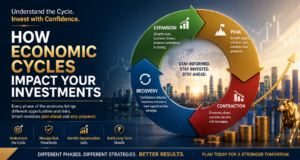
How Economic Cycles Impact Your Investments
Understanding how economic cycles impact your investments is essential for making informed financial decisions and building long-term wealth. Market conditions constantly change due to economic growth, inflation, interest rates, and global events. Investors who understand these cycles are better prepared to manage risk, protect their portfolios, and identify growth opportunities.
At ACME Group, we believe successful investing is not about reacting emotionally to market movements — it’s about understanding economic trends and creating strategies that perform across every market phase.
What Are Economic Cycles?
Economic cycles, also known as business cycles, refer to the natural fluctuations in economic activity over time. These cycles generally move through four phases:
- Expansion
- Peak
- Contraction
- Recovery
Each phase affects businesses, industries, and investment markets differently.
Expansion Phase: Growth Opportunities Increase
During an expansion phase, the economy grows steadily. Businesses perform well, employment rises, and consumer spending increases. Investor confidence also remains strong.
Impact on Investments
- Stock markets often perform positively
- Equity mutual funds may generate higher returns
- Growth sectors like banking, infrastructure, and technology benefit
At ACME Group, we help investors identify high-growth opportunities during expansion phases while maintaining balanced portfolio strategies.
Peak Phase: Managing Market Volatility
The peak phase occurs when economic growth reaches its highest point before slowing down. Inflation and interest rates may rise, increasing market uncertainty.
Impact on Investments
- Market volatility may increase
- Some sectors become overvalued
- Diversification becomes crucial
ACME Group focuses on portfolio optimisation and risk management strategies to help investors stay protected during uncertain market conditions.
Contraction Phase: Protecting Wealth During Slowdowns
A contraction phase is marked by slowing economic activity, lower corporate earnings, and reduced consumer demand.
Impact on Investments
- Stock markets may experience corrections
- Defensive investments become more important
- Investors often move toward stable assets
Rather than reacting emotionally, ACME Group helps investors stay disciplined through research-driven advisory and long-term investment planning.
Recovery Phase: Rebuilding Confidence and Growth
The recovery phase begins when the economy gradually improves after a slowdown. Market sentiment strengthens, and investment opportunities re-emerge.
Impact on Investments
- Equity markets often recover early
- SIP investments benefit from lower valuations
- Long-term wealth creation opportunities increase
ACME Group helps investors identify recovery-driven opportunities and position portfolios for sustainable future growth.
Why Diversification Matters Across Economic Cycles
Different asset classes perform differently during changing market conditions. A diversified portfolio helps reduce risk and improve stability.
A smart portfolio typically includes:
- Equity investments for long-term growth
- Debt investments for stability
- Gold and alternative assets for risk management
At ACME Group, we create customised investment strategies aligned with each client’s goals, risk profile, and market conditions.
Final Thoughts
Economic cycles are a natural part of every financial market. While markets may fluctuate, disciplined investing and strategic planning remain the key to long-term success.
With deep market expertise, personalised financial planning, and research-backed investment strategies, ACME Group helps investors navigate every economic cycle with confidence, clarity, and long-term vision.
